The derivative of the natural logarithm function, written as ln(x), is simply $1/x$ for all $x > 0$. This clean reciprocal rule sits at the heart of differential calculus. Whenever you differentiate ln(x) with respect to $x$, the output is the inverse of the input value.
Understanding why this works requires looking at both the geometric meaning and the underlying proofs. Beyond the basic formula, working with natural logarithms involves applying log properties, navigating the chain rule for composite functions, and handling absolute values for negative inputs. Let's break down how the rule functions, how to prove it, and how to apply it across different mathematical scenarios.
The Core Formula and Geometric Meaning
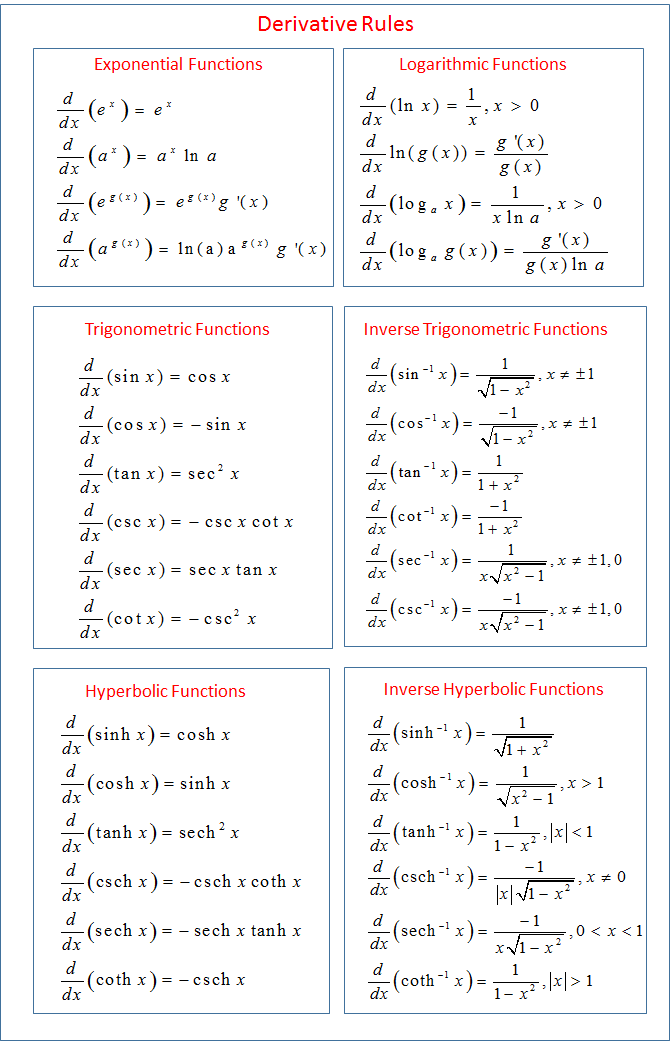
The primary rule states that for $f(x) = \ln(x)$, the derivative is:
$$\frac{d}{dx} (\ln x) = \frac{1}{x}$$
Geometrically, this means that if you sketch the curve of $y = \ln(x)$, the slope of the tangent line at any specific point $x$ equals $1/x$. When $x$ is small and close to zero, such as $x = 0.5$, the slope of the curve is steep ($2$). As $x$ grows larger, like $x = 10$, the curve flattens out, and the slope drops to $0.1$.
It's vital to remember that the domain of $\ln(x)$ is restricted to strictly positive numbers ($x > 0$). You can't take the natural log of zero or a negative number because there is a vertical asymptote at $x = 0$. Consequently, the derivative is also only defined for $x > 0$.
When working with broader functions, mathematicians often use the absolute value notation:
$$\frac{d}{dx} (\ln |x|) = \frac{1}{x}$$
This extension allows the derivative to apply to negative inputs as well, since the domain of $\ln|x|$ includes all real numbers except zero.
How to Prove the Derivative of ln(x)
Calculus students typically encounter two standard methods to prove that the derivative of $\ln(x)$ is $1/x$: using the limit definition (the first principle) and using implicit differentiation.
Proof 1: Using the Limit Definition
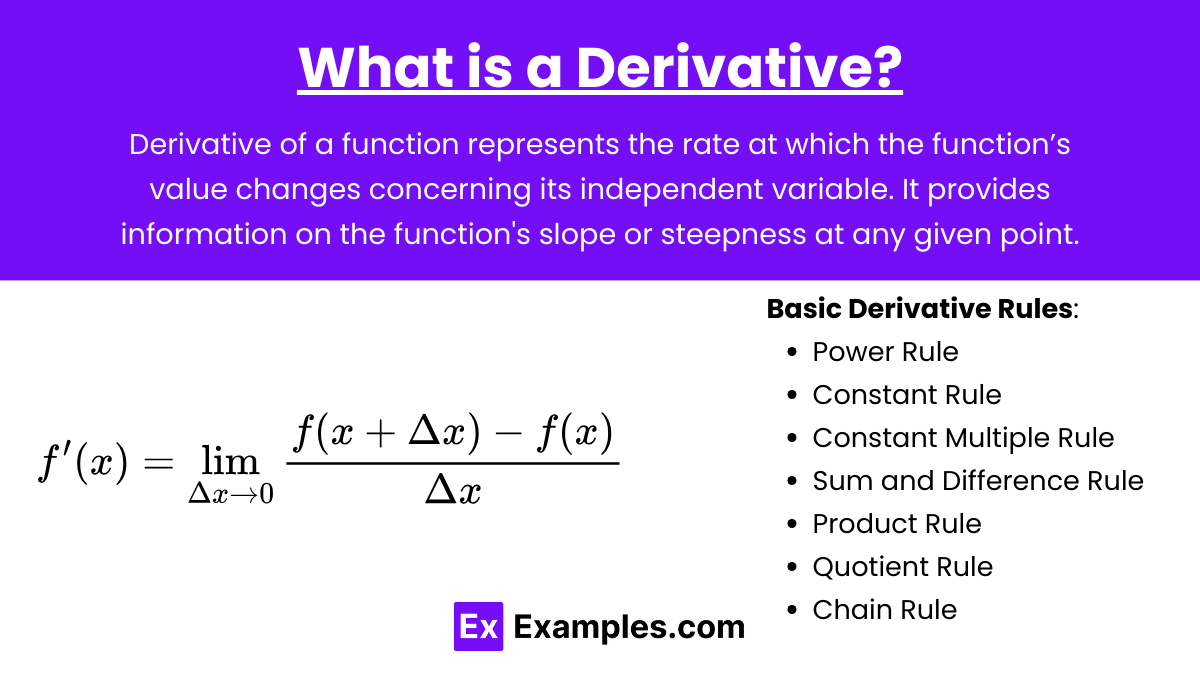
The limit definition of a derivative states that:
$$f'(x) = \lim_{h \to 0} \frac{f(x + h) - f(x)}{h}$$
Substitute $f(x) = \ln(x)$ into this expression:
$$f'(x) = \lim_{h \to 0} \frac{\ln(x + h) - \ln(x)}{h}$$
Apply the logarithm subtraction rule, which states that $\ln(a) - \ln(b) = \ln(a/b)$:
$$f'(x) = \lim_{h \to 0} \frac{1}{h} \ln\left(\frac{x + h}{x}\right)$$
Rewrite the fraction inside the log:
$$f'(x) = \lim_{h \to 0} \frac{1}{h} \ln\left(1 + \frac{h}{x}\right)$$
Next, let $t = h/x$. As $h$ approaches $0$, $t$ also approaches $0$. Also, $h = xt$. Substitute these into the limit:
$$f'(x) = \lim_{t \to 0} \frac{1}{xt} \ln(1 + t) = \frac{1}{x} \lim_{t \to 0} \frac{1}{t} \ln(1 + t)$$
Using the power rule for logarithms, $1/t \cdot \ln(1 + t) = \ln\left((1 + t)^{1/t}\right)$:
$$f'(x) = \frac{1}{x} \ln\left( \lim_{t \to 0} (1 + t)^{1/t} \right)$$
The limit inside the parentheses is the definition of Euler's number, $e$. Therefore:
$$f'(x) = \frac{1}{x} \ln(e)$$
Since $\ln(e) = 1$, the final result simplifies to:
$$f'(x) = \frac{1}{x}$$
Proof 2: Using Implicit Differentiation
Another approach relies on the exponential function, which is the inverse of the natural logarithm. Start by setting:
$$y = \ln(x)$$
Rewrite this logarithmic equation in its exponential form:
$$e^y = x$$
Differentiate both sides with respect to $x$ using the chain rule:
$$\frac{d}{dx}(e^y) = \frac{d}{dx}(x)$$
$$\implies e^y \cdot \frac{dy}{dx} = 1$$
Solve for the derivative $dy/dx$:
$$\frac{dy}{dx} = \frac{1}{e^y}$$
Since we established earlier that $e^y = x$, substitute $x$ back into the denominator:
$$\frac{dy}{dx} = \frac{1}{x}$$
This confirms the derivative through exponential properties and implicit differentiation.
Applying Log Rules Before Differentiating
Sometimes, raw expressions look messy. Trying to differentiate a complex logarithmic function straight away leads to cumbersome algebra. Simplifying the expression using standard logarithm properties first makes the process much smoother.
Consider the properties:
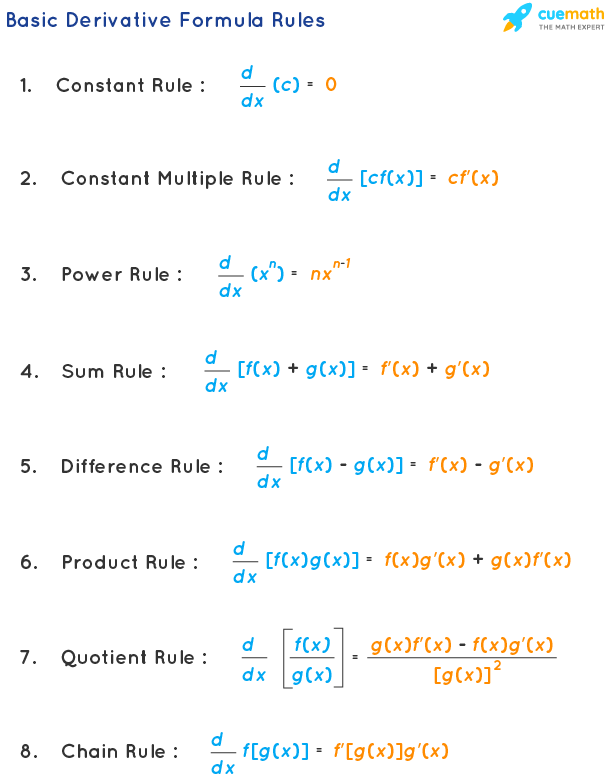
- Product Rule: $\ln(ab) = \ln(a) + \ln(b)$
- Quotient Rule: $\ln(a/b) = \ln(a) - \ln(b)$
- Power Rule: $\ln(a^k) = k \ln(a)$
For example, if you need to find the derivative of $f(x) = \ln(3x^2)$, applying the product rule first splits it into:
$$f(x) = \ln(3) + \ln(x^2)$$
Using the power rule brings the exponent down:
$$f(x) = \ln(3) + 2\ln(x)$$
Now, take the derivative term by term. The term $\ln(3)$ is a constant, so its derivative is $0$. The derivative of $2\ln(x)$ is simply $2/x$. This is far faster than using the chain rule directly on the original expression.
Working With the Chain Rule
Real-world calculus problems rarely feature a plain $x$ inside the logarithm. Instead, you'll encounter composite functions where the input is an entire expression, written as $\ln(f(x))$.
The chain rule for natural logarithms states:
$$\frac{d}{dx} \left( \ln(f(x)) \right) = \frac{1}{f(x)} \cdot f'(x)$$
Put simply: put the inside function in the denominator, then multiply by the derivative of that inside function.
Worked Example 1: Polynomial Inside a Log
Find the derivative of $f(x) = \ln(4x^3 - 5x + 2)$.
- Identify the inner function: $f(x) = 4x^3 - 5x + 2$.
- Find its derivative: $f'(x) = 12x^2 - 5$.
- Apply the chain rule formula:
$$f'(x) = \frac{1}{4x^3 - 5x + 2} \cdot (12x^2 - 5) = \frac{12x^2 - 5}{4x^3 - 5x + 2}$$
Worked Example 2: Trigonometric Function Inside a Log
Find the derivative of $g(x) = \ln(\sin(x))$.
- The inner function is $\sin(x)$.
- Its derivative is $\cos(x)$.
- Put the inner function on the bottom and multiply by its derivative:
$$g'(x) = \frac{1}{\sin(x)} \cdot \cos(x) = \frac{\cos(x)}{\sin(x)} = \cot(x)$$
This neat result shows that the derivative of $\ln(\sin(x))$ simplifies down to the cotangent function.
Common Mistakes to Avoid
Calculus learners often hit stumbling blocks when dealing with logarithms. Watch out for these frequent errors:
- Confusing log base 10 with natural log: The standard common logarithm, written as $\log(x)$ or $\log_{10}(x)$, has a different derivative. While $\frac{d}{dx}(\ln x) = \frac{1}{x}$, the derivative of base-10 log is $\frac{d}{dx}(\log_{10} x) = \frac{1}{x \ln(10)}$. Don't forget that extra $\ln(10)$ scaling factor.
- Forgetting the chain rule: When differentiating something like $\ln(5x)$, students sometimes write just $\frac{1}{5x}$ and stop. You must multiply by the derivative of the inner function ($5$), resulting in $\frac{5}{5x}$, which simplifies to $\frac{1}{x}$.
- Applying the derivative to negative numbers: Plugging a negative number into a derivative like $1/x$ yields a negative slope, but the original $\ln(x)$ function doesn't accept negative inputs. Always verify that your input value respects the domain of the initial logarithmic expression.
Frequently Asked Questions
What is the second derivative of ln(x)?
The first derivative of $\ln(x)$ is $x^{-1}$. To find the second derivative, differentiate $1/x$ using the power rule: $$\frac{d^2}{dx^2} (\ln x) = \frac{d}{dx}(x^{-1}) = -1x^{-2} = -\frac{1}{x^2}$$
How do you find the derivative of x * ln(x)?
This requires the product rule, which states that $(uv)' = u'v + uv'$. Let $u = x$ and $v = \ln(x)$.
- The derivative of $u$ is $1$.
- The derivative of $v$ is $1/x$. Plugging these into the formula: $$\frac{d}{dx}(x \ln x) = (1)(\ln x) + (x)\left(\frac{1}{x}\right) = \ln(x) + 1$$
Can you integrate 1/x?
Yes. Integration is the reverse of differentiation. Because the derivative of $\ln(x)$ is $1/x$, integrating $1/x$ with respect to $x$ yields the natural log: $$\int \frac{1}{x} , dx = \ln|x| + C$$ The absolute value bars and the constant of integration $C$ are required to ensure the formula holds true across negative domains.
Why doesn't the power rule work on ln(x)?
The power rule states that $\frac{d}{dx}(x^n) = n x^{n-1}$. Students sometimes try to rewrite $\ln(x)$ as an exponent or confuse it with power functions. However, $\ln(x)$ is a transcendental function, not a power function. Its rate of change is proportional to the reciprocal of the input rather than polynomial growth, which is why the limit definition yields $1/x$ instead.