The derivative of the natural logarithm function, written as $\frac{d}{dx}[\ln(x)] = \frac{1}{x}$, is one of the most useful rules in calculus. If you're tackling exponential growth, optimization, or complex integration, this formula is your starting point. It bridges linear rates of change with exponential functions like $e^x$, making it essential for solving real-world differential equations.
Many textbooks state this rule as a memorization shortcut, leaving out why it works or how to handle variations like $\ln(2x)$ or $\ln(x^2 + 5)$. We'll walk through the exact proof using first principles, explore practical examples, and look at common mistakes you'll want to avoid.
Defining the Natural Logarithm
To understand why its derivative is $\frac{1}{x}$, we first need to look at what $\ln(x)$ represents. The natural logarithm is the inverse of the exponential function $e^x$. If $y = \ln(x)$, then $e^y = x$.
Calculus also defines $\ln(x)$ using an integral:
$$\ln(x) = \int_{1}^{x} \frac{1}{t} , dt \quad \text{for } x > 0$$
This definite integral represents the exact area under the curve $f(t) = \frac{1}{t}$ from $1$ to $x$. When $x$ is greater than $1$, this area is positive. When $x$ is between $0$ and $1$, the area is negative. This integral definition isn't just theoretical; it ties directly into the Fundamental Theorem of Calculus, which states that the derivative of an integral is the integrand itself.
The Proof Using First Principles
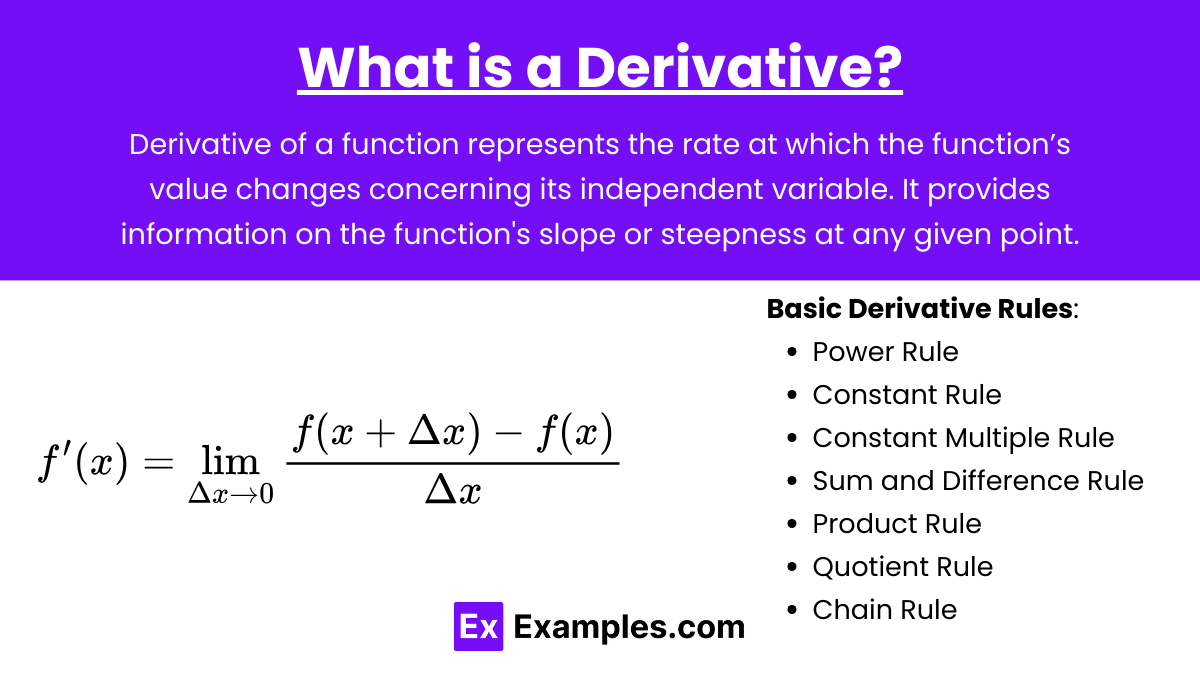
We can derive $\frac{1}{x}$ directly from the limit definition of a derivative (first principles).
Let $f(x) = \ln(x)$. The derivative formula is:
$$f'(x) = \lim_{h \to 0} \frac{\ln(x + h) - \ln(x)}{h}$$
Using the logarithm subtraction property ($\ln(a) - \ln(b) = \ln(\frac{a}{b})$), we rewrite the numerator:
$$f'(x) = \lim_{h \to 0} \frac{1}{h} \ln\left(\frac{x + h}{x}\right)$$
This simplifies inside the logarithm:
$$f'(x) = \lim_{h \to 0} \frac{1}{h} \ln\left(1 + \frac{h}{x}\right)$$
Now, apply a substitution. Let $n = \frac{h}{x}$, which means $h = nx$. As $h \to 0$, $n \to 0$ as well. Substitute $h$ and $n$ into our limit:
$$f'(x) = \lim_{n \to 0} \frac{1}{nx} \ln(1 + n) = \frac{1}{x} \cdot \lim_{n \to 0} \frac{1}{n} \ln(1 + n)$$
Using the power rule for logarithms ($\ln(a^b) = b \ln(a)$), the limit expression becomes:
$$\lim_{n \to 0} \ln\left((1 + n)^{\frac{1}{n}}\right)$$
By definition, Euler's number $e$ is expressed as $\lim_{n \to 0} (1 + n)^{\frac{1}{n}} = e$. Substituting this in gives:
$$\ln(e) = 1$$
Multiply this back by our $\frac{1}{x}$ factor, and you get:
$$\frac{d}{dx}[\ln(x)] = \frac{1}{x}$$
For a deeper dive into limits and foundational definitions, check out the Khan Academy Calculus Guide.
The Chain Rule With Logarithms
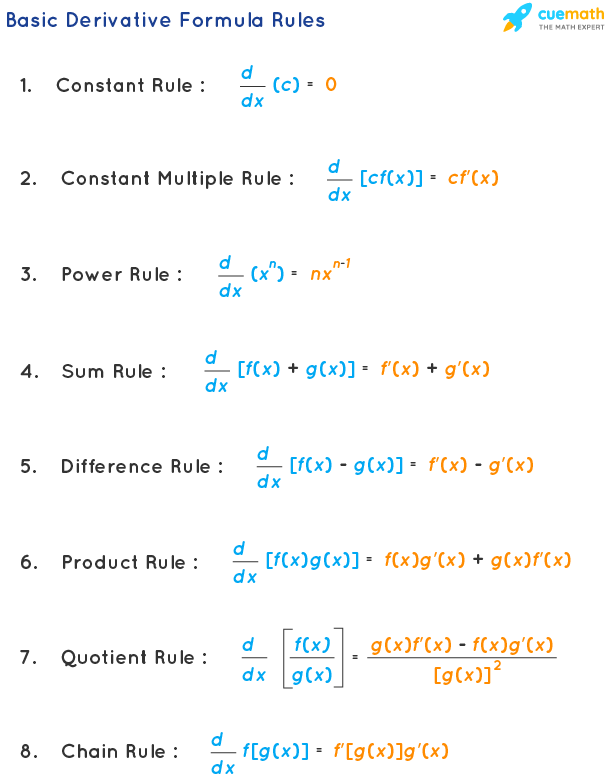
In actual problem-solving, you rarely see a standalone $\ln(x)$. You'll usually encounter composite functions like $\ln(g(x))$. To differentiate these, you need the chain rule.
The generalized formula is:
$$\frac{d}{dx}[\ln(g(x))] = \frac{1}{g(x)} \cdot g'(x) = \frac{g'(x)}{g(x)}$$
Step-by-Step Example 1: Differentiating $\ln(3x^2 + 5)$
- Identify the inner function: $g(x) = 3x^2 + 5$.
- Find the derivative of the inner function: $g'(x) = 6x$.
- Apply the formula $\frac{g'(x)}{g(x)}$:
$$\frac{d}{dx}[\ln(3x^2 + 5)] = \frac{6x}{3x^2 + 5}$$
Step-by-Step Example 2: Differentiating $\ln(\sin(x))$
- Let $g(x) = \sin(x)$.
- The derivative is $g'(x) = \cos(x)$.
- Set up the fraction:
$$\frac{d}{dx}[\ln(\sin(x))] = \frac{\cos(x)}{\sin(x)} = \cot(x)$$
For official curriculum standards and problem sets on trigonometric and logarithmic derivatives, review the AP Calculus Course Overview.
Logarithmic Differentiation
When a function looks too complicated for standard product or quotient rules—such as variables raised to variable powers—you can use logarithmic differentiation.
Consider finding the derivative of $y = x^x$.
- Take the natural logarithm of both sides: $$\ln(y) = \ln(x^x)$$
- Bring the exponent down using log rules: $$\ln(y) = x \ln(x)$$
- Differentiate both sides with respect to $x$ (remembering implicit differentiation on the left): $$\frac{1}{y} \frac{dy}{dx} = (1) \cdot \ln(x) + x \cdot \left(\frac{1}{x}\right)$$ $$\frac{1}{y} \frac{dy}{dx} = \ln(x) + 1$$
- Solve for $\frac{dy}{dx}$ by multiplying both sides by $y$: $$\frac{dy}{dx} = y(\ln(x) + 1)$$
- Substitute back $y = x^x$: $$\frac{dy}{dx} = x^x(\ln(x) + 1)$$
Common Mistakes to Avoid
- Forgetting absolute value bars: Technically, $\frac{d}{dx}[\ln|x|] = \frac{1}{x}$ for all $x \neq 0$. If you forget the absolute value in integration ($ \int \frac{1}{x} dx = \ln|x| + C $), you restrict your domain unnecessarily for negative numbers.
- Confusing log bases: The derivative rule $\frac{1}{x}$ applies specifically to the natural logarithm ($\log_e$). For base-10 logs ($\log_{10}(x)$), the derivative includes a scaling factor: $\frac{d}{dx}[\log_{10}(x)] = \frac{1}{x \ln(10)}$.
- Misapplying the chain rule: Don't forget to multiply by the derivative of the inside function. The derivative of $\ln(5x)$ is $\frac{5}{5x} = \frac{1}{x}$, not just $\frac{1}{5x}$.
Frequently Asked Questions
Why is the derivative of $\ln(x)$ not defined at $x = 0$?
The original function $\ln(x)$ has a vertical asymptote at $x = 0$ and is only valid for $x > 0$. Since the function doesn't exist for zero or negative numbers on the real number line, its rate of change cannot be calculated there either.
How does $\ln(x)$ relate to Euler's number $e$?
Euler's number $e$ ($2.71828...$) is the unique base where the slope of the exponential function $e^x$ at $x = 0$ equals $1$. Because $\ln(x)$ is the inverse of $e^x$, this symmetry results in a clean derivative of $\frac{1}{x}$ without awkward constant multipliers.
Can you take the derivative of negative log values?
No, real-valued natural logarithms cannot accept negative inputs. If you need to handle expressions where inputs might be negative, use absolute value notation inside the logarithm ($\ln|x|$), which expands the valid domain to all non-zero real numbers.
What is the integral counterpart to this derivative?
Because differentiation and integration are inverse operations, integrating $\frac{1}{x}$ reverses the derivative rule:
$$\int \frac{1}{x} , dx = \ln|x| + C$$
Always include the constant of integration $C$ and absolute value bars unless the problem specifies a positive domain.