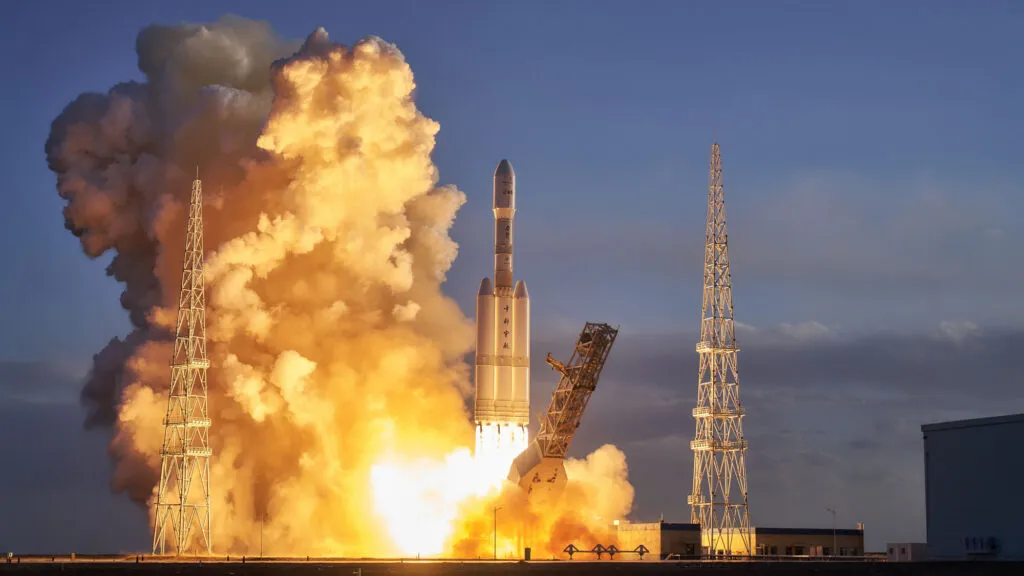
When people ask how long it takes to get to the Moon, the standard answer is usually three days. Yet that simple figure masks a complex web of physics, orbital mechanics, and mission architecture. Reaching lunar orbit, touching down on the surface, or flying past the Moon all involve vastly different timelines.
The distance between Earth and the Moon sits at an average of roughly 240,000 miles (384,400 kilometers). Because both bodies travel along elliptical paths rather than static circles, that gap shifts constantly by tens of thousands of miles. A spacecraft doesn't fly in a straight line either; it rides an invisible ocean of gravitational forces, momentum, and fuel management strategies that dictate every hour of the journey.
The Standard Three-to-Five-Day Window
For most crewed missions, the transit duration hovers between three and five days. Historic and modern flights illustrate how trajectory choices alter this window significantly.
- Apollo 11 (1969): The historic mission entered lunar orbit after 75 hours and 50 minutes—just over three days. Touching down on the surface took a total of 102 hours and 45 minutes from launch.
- Artemis I (2022): NASA's uncrewed test flight took five days to reach the Moon, utilizing an efficient, fuel-saving transfer orbit rather than a rushed direct route.
- Artemis II (2026): This crewed flyby mission required a full five days to reach its lunar milestone, prioritizing a safe free-return trajectory that allows the spacecraft to loop back to Earth naturally if propulsion systems fail.
Why Speed Isn't Everything in Space Travel
Physics dictates that a spacecraft leaving Earth must fight Earth's immense gravity well. During the first few hours after launch, a rocket executes a trans-lunar injection burn, hurling itself outward at speeds exceeding 24,000 miles per hour. Further insight on this matter has been provided by BBC.
Once the engines cut off, Earth's gravity acts like an invisible anchor, constantly pulling backward on the spacecraft. The vehicle slows down steadily during the first half of the trip until it crosses the gravitational tipping point—the Lagrange point or sphere of influence where the Moon's gravity begins to pull harder than Earth's. From that moment onward, the spacecraft accelerates toward the Moon, requiring a braking burn (lunar orbit insertion) to avoid crashing into the lunar surface.
Trying to get there faster requires exponentially more fuel. Carrying extra propellant adds massive weight to the initial launch, making the rocket larger, more expensive, and technically challenging. Space agencies balance speed against safety margins, radiation exposure in deep space, and fuel efficiency.
Alternative Timelines: From Hours to Months
Depending on the mission type, the timeline changes drastically:
- Flybys and Impactors: Uncrewed probes designed simply to crash into the Moon or zip past it without slowing down can make the trip much faster. NASA's New Horizons probe crossed the Moon's orbit in just over 8 hours on its high-speed trajectory toward Pluto.
- Low-Thrust Ion Engines: Robotic spacecraft using electric propulsion or ion drives take a radically different approach. Instead of a fast, explosive rocket burn, they spiral outward from Earth over weeks or months. SMART-1, a European Space Agency lunar orbiter, took over a month just to reach its destination using a highly efficient ion engine.
Hypothetical Commutes: What If We Drove?
To put the cosmic distance into perspective, imagine an open highway stretching straight from Earth to the Moon. Maintaining a steady highway speed of 80 miles per hour without stopping for gas, food, or sleep would keep you behind the wheel for roughly 123 days straight.
Commercial jetliners cruise at a brisk 500 miles per hour, which would shrink that Earth-to-Moon flight time to about 18 days of continuous flying. Sound travels through the air at roughly 768 miles per hour, taking about 13 days to cover the distance. Light beats them all effortlessly, crossing the gap between Earth and the Moon in a mere 1.28 seconds.
Frequently Asked Questions
Does the Moon's orbit change the travel time?
Yes. Because the Moon's orbit is elliptical, its distance from Earth varies by about 30,000 miles between its closest point (perigee) and farthest point (apogee). Missions must time their launches precisely to match these orbital dynamics.
Why do modern Artemis missions take longer than Apollo?
Modern safety protocols heavily influence mission design. Artemis missions often utilize wider, highly stable trajectories and extensive system checkouts in high Earth orbit before committing to deep space, adding a couple of days to the transit time compared to the rushed space race era of the 1960s.
How long does the entire round trip take?
A complete crewed lunar mission typically spans about a week to a week and a half. For instance, Apollo 11 lasted 8 days, 3 hours, and 18 minutes from launch to Pacific splashdown, including surface exploration.
Can a cargo ship or automated drone get there faster than humans?
Uncrewed cargo drones can utilize aggressive, high-thrust direct trajectories that shave off travel time, but most commercial lunar landers take between four to six days to ensure safe orbital capture and gentle touchdown procedures.